A TRIBESMAN EXPLORES IRELAND’S VIKING PAST by T.C.
When most people picture Ireland, they might be thinking of lush green hills, ancient Celtic folklore, and old castles. But if you dig just an inch beneath the pavement in modern Dublin and across the historic cities of the south, you run straight into a completely different world: the world of the Vikings.

Long before it was the bustling capital of the Emerald Isle, Dublin was a fortified Norse settlement called Dyflin. But on my recent trip, I wanted to follow the full trail of their expansion. My journey started on the spectacular western coast before diving deep into the history of Limerick—a city founded not by Irish kings, but by Norse longship captains over a thousand years ago.
First Stop: The Western Edge and an Unexpected Local
Before diving into the city of Limerick itself, we made our way out to the spectacular Cliffs of Moher. Standing on the edge of those 700-foot drops, looking out at the Atlantic, you get a real physical sense of what the Vikings saw from their open longships.
While the ancient Icelandic Sagas don’t mention the Cliffs of Moher by name, we know exactly how Viking helmsmen operated. They sailed without maps or compasses, relying entirely on memory, oral navigation chants, and massive coastal landmarks to find their way. A 700-foot sheer wall of black stone dropping straight into the Atlantic is impossible to miss. For a Norse crew looking to turn inward toward the River Shannon to raid or trade, these cliffs were the ultimate signpost.
The views were incredible, but one of the coolest moments was completely unplanned. A park ranger handed me some peanuts, and before I knew it, I had a wild rook (a relative of the crow and raven) eating right out of my hand. In Norse mythology, Odin had two ravens, Huginn and Muninn, that flew around the world to bring him information. I like to think this local rook was just checking up on me to see what a traveler was doing on his cliffs.

Limerick: The Western Stronghold
Phase 1: The Longphort (922 AD)
To really understand Limerick, you must look past the medieval stone and picture this place in the year 922 AD. That was the year a Viking chieftain named Thormodr Helgason sailed a fleet of longships up the River Shannon and staked a claim on King's Island.
They didn't arrive with blueprints for a town. Instead, they built a longphort—which was essentially a heavily fortified, winter-ready naval base. They dug deep ditches, threw up massive earthen ramparts, and lined them with sharpened wooden stakes to protect their ships from Irish counter-attacks.
That’s what makes exploring the city's old footprint so fascinating. When you look at the surviving fragments of the medieval stone walls today, you aren't looking at a brand-new Norman design. You’re looking at a permanent boundary line drawn by those original Norse sailors over a thousand years ago. They laid the tracks, and every civilization that followed just built on top of them.
Phase 2: The Money Trail at the Hunt Museum
Once the gritty pirate camp established itself, the Vikings did what they did best: they traded. Within a few decades, that muddy ship encampment evolved into a permanent, wealthy trading hub.
To see the proof of that wealth, our next stop was the Hunt Museum. The museum itself has a cool backstory—it’s essentially a massive private collection gathered by a wealthy couple, John and Gertrude Hunt, in the 20th century. Walking through it feels like exploring a high-end treasure room.
I got a close-up look at a spectacular Silver Thistle Brooch from the 9th or 10th century. These things were huge, used by high-status guys to pin heavy cloaks over their shoulders. It perfectly captures a bridge between cultures—the shape is traditionally Irish, but the high-purity silver came straight out of the Viking trade network.
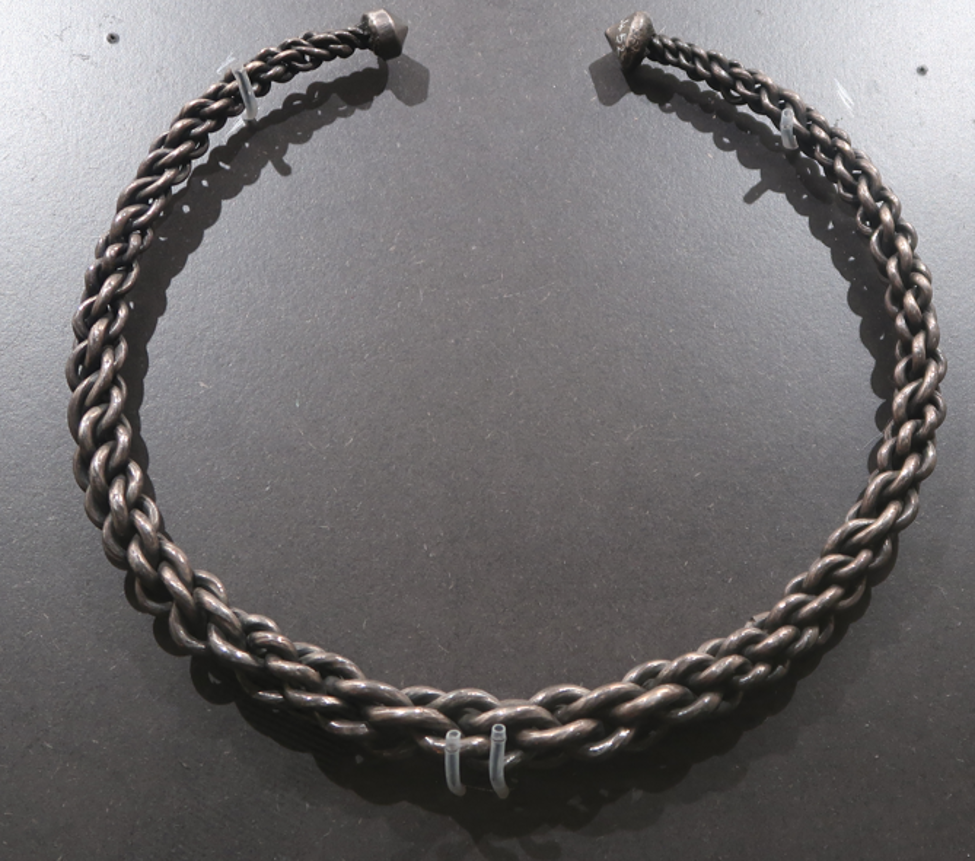
My favorite piece, though, was a twisted silver neck-ring. To the Irish, it was a status symbol, but to a Viking, it was a wallet. They traded by pure bullion weight rather than minted coins. If they needed to buy something at a market, they’d literally chop off a chunk of their jewelry—what historians call "hacksilver"—and throw it onto a set of portable balance scales. One of the fascinating details I learned on this trip is that almost every Norse merchant carried their own folding scales and lead counterweights. Across archaeological digs throughout the Viking world, these recovered weights match each other remarkably closely, proving they operated on a sophisticated, standardized weight system. If you look closely at the ring in the display, you can even spot a tiny test nick in the metal where a medieval merchant checked the purity of the silver before accepting it.
They also had a stunning later-era drinking horn mounted in silver. Even though it's from a few centuries after the height of the Viking raids, it perfectly captures that enduring Scandinavian feasting tradition.

Phase 3: The Ostman Houses Under the Castle
To see what daily life actually looked like as the Viking Age wound down, we toured King John's Castle. While the massive stone towers above ground get all the attention, the real treasure is hidden directly beneath them in the castle's undercroft.
When archaeologists excavated beneath the courtyard in the 1990s, they found the preserved ruins of a unique neighborhood. The info boards describe the people who lived here as Ostmen (meaning "Eastmen"). These weren't raiders fresh off a longship; they were the descendants of the original Vikings who had intermarried with the local Irish over generations.
Looking at the ruins, you realize these Ostmen were wealthy, high-status merchants. They built sophisticated houses with deep, stone-lined sunken basements to store their trade goods, living on the main floor above. They even engineered clever drainage "sumps" and removable wooden steps to deal with the constant Irish rain and flooding.
Looking down into the excavation, you see the physical transition from the Viking Age to the Norman era. When the Anglo-Normans arrived in 1175, they built an earthen ringwork fortification right beside this neighborhood. By 1212, as the stone castle began to take shape, the fortification cut off the Ostmen's main road to the north. While these wealthy merchant homes initially continued to stand alongside the early garrison, later expansions of the stone castle eventually enveloped the site, preserving the basement foundations beneath the courtyard.

Phase 4: Final Finds at Limerick Museum and the Treaty Stone
To round out our time in Limerick proper, I visited the Limerick City Museum to look for the literal smoking guns of the Norse era.
The collection didn't disappoint. They have a remarkably intact Viking Spearhead from the 9th to 11th century that was pulled right out of the local County Limerick soil. Seeing the pitting in the iron of a weapon that likely saw action on the Shannon really drives home the reality of the era.

They also display a small fragment of a Viking-period decorated stone found at Ballynanty. The intricate, interlocking loops and spiral carvings are textbook Scandinavian design elements from the peak of their settlement here.

Phase 5: The Assembly at Saint Mary's Cathedral
As the Norsemen integrated into Ireland, they established their own systems of law and order. Just a short walk away, we headed over to Saint Mary's Cathedral on King’s Island to see where that happened.
It’s the oldest building in Limerick still in daily use, dating all the way back to 1168. While walking through the quiet nave, you won't find a giant sign pointing out the Viking history, but the brochure clued me into something incredible about the dirt beneath my feet. This entire cathedral was built directly on top of Limerick's ancient Thingmote.
To the Norsemen, a Thingmote was their open-air parliament, court, and political heart. This particular spot was the most westerly Viking government stronghold in all of Europe. Centuries later, an Irish King named Donal Mór O'Brien kicked the Vikings out, built his personal palace right over their assembly ground, and eventually gifted that palace to the church to build this cathedral. It's wild to realize that the political center of the Viking city is still the heart of the city today.
Expanding the Horizon: Rooks and Wights at Bunratty
Just a short drive down the road sits Bunratty Castle and Folk Park. The towering stone fortress you see today is a 15th-century medieval stronghold rather than a Norse one, though the Vikings did maintain a short-lived camp on these very riverbanks in the late 900s.
What really caught my eye here wasn't the masonry, but the living culture and wildlife on the grounds.
While stopping for a bite to eat, I noticed that the building featured a built-in stone rookery. It was full of active, vocal rooks that appeared to be closely mated pairs, constantly interacting and keeping watch over the patio. Having encountered another bold rook earlier at the Cliffs of Moher, it felt like a running theme for the trip—and a very Norse one at that, given how central intelligent corvids are to the old Scandinavian worldview.
The park also features a sprawling Fairy Garden nestled into the woods, filled with miniature houses and hidden villages tucked into the moss and tree roots.
Walking through the trees, it struck me how beautifully this reveals a shared ancestral mindset. The deep-rooted belief the Irish have in the Aos Sí (the Good Neighbors or small folk) perfectly mirrors the old Norse belief in the Landvættir (land wights or spirits). To both cultures, the landscape wasn't just dirt and trees; it was a living, breathing space inhabited by hidden guardians that demanded respect.


The Vikings may have eventually traded their swords for merchant scales and vanished into the local population, but that fundamental, mystical connection to the Irish land and its oldest traditions never truly faded.
Waterford: Ireland’s Oldest City and the Viking Triangle
If Limerick was the western outpost on the Shannon, Waterford (Veðrafjǫrðr) was the beating heart of Norse power in the southeast. Stepping into the city’s Viking Triangle, you immediately sense how proud this city is of its founding roots—and it quickly became our absolute favorite spot on the entire trip.
Phase 1: Boundary Posts and Longships
Walking through the old city, the first thing that grabs your attention are the massive wooden markers carved with intricate Norse motifs and beast heads, tracing the footprint of the original 10th-century fortified triangle.


Right beside Reginald's Tower sits a full-scale reproduction of a Viking longship (Vadrafjordr). Seeing that wooden hull resting beside the massive stone fortress brings the dual nature of Waterford—part naval base, part trading empire—right to life.

Throughout the streets, unique and well-designed info kiosks map out detailed timelines and history, bridging the gap between the initial raiders and the eventual urban settlement.
Phase 2: Reginald’s Tower and the Broken Sword
At the tip of the triangle stands Reginald’s Tower, named after Ragnall mac Ímair, the Viking king who founded the city in 914 AD. While the current stone structure was reinforced by the Anglo-Normans, it sits on the exact spot of the original wooden fort and remains the oldest civic building in Ireland.
The tower is a direct link to Ireland's military history—and if you look high up on the outer stone wall, you can still see an authentic iron cannonball firmly lodged in the masonry. It’s a battle scar left behind from the violent 1650 Parliamentary siege of the city led by Oliver Cromwell, when warships on the nearby River Suir heavily bombarded the fortress.
Inside, the museum houses some of the most significant Viking artifacts ever uncovered in Ireland:
Hnefatafl Gaming Set: A 12th-century wooden board drilled with peg holes (so pieces wouldn't slide around on a rolling ship) alongside antler and yew wood game pieces. Playing Hnefatafl at our Viking Camp gives you a deep appreciation for these—it wasn't just a game to them, but a way to teach tactical strategy to fighters.

The Broken Grave Sword: A heavy Scandinavian sword pulled from a burial site, deliberately snapped into pieces before being laid with the warrior. Looking at a high-status shattered blade immediately brings Narsil from The Lord of the Rings to mind. J.R.R. Tolkien relied extensively on authentic Old Norse sagas and funerary practices for his work, and standing over the display case makes you realize that modern fantasy has its roots firmly planted in true Viking history.

Phase 3: The King of the Vikings Experience & Longhouse
Just around the corner, we stopped by King of the Vikings, a VR-heavy experience housed inside a meticulously constructed reproduction wattle-and-daub longhouse.
The VR experience itself was absolutely first-rate—a quick, immersive thrill ride that transported you right into 10th-century Waterford. While you can't bring a camera inside the VR headset itself, stepping back into the longhouse afterward was equally rewarding. The docent was a trained archaeologist who had actively worked on local digs and gave incredible insight into the day-to-day Viking influence across the region.
Phase 4: The Marriage of Strongbow & Aoife and Crown Invasions
Throughout Waterford, you see frequent references to the 1170 marriage of the Anglo-Norman leader Strongbow (Richard de Clare) and Aoife, daughter of Dermot MacMurrough, King of Leinster. It is remembered as one of the most pivotal turning points in all Irish history—a moment that fundamentally altered the political destiny of the island forever.
This union was struck as a calculated political pact: in exchange for providing mercenary forces to help Dermot reclaim his throne, Strongbow was promised Aoife’s hand in marriage and succession to the kingship of Leinster.
When Dermot died shortly after in May 1171, Strongbow wasted no time claiming the title of King of Leinster for himself. This bold power grab immediately alarmed King Henry II of England, who feared his ambitious baron would carve out an independent rival Norman kingdom right on his doorstep. In October 1171, Henry II sailed directly into Waterford with an armada of 400 ships and 4,000 men to force Strongbow’s unconditional submission. By claiming Waterford, Dublin, and the coastal strongholds directly for the Crown, Henry II officially established the Lordship of Ireland. That royal intervention triggered centuries of English military campaigns—leading all the way to King Richard II landing his own fleet at Waterford in 1394 and using Reginald's Tower as his personal munitions storehouse to try and reassert control over a restless island.
Yet, this kind of cross-cultural blending was nothing new for Ireland. Long before the Normans arrived, the Vikings and the native Irish had spent centuries intertwining their dynasties. While early contact was defined by coastal raids, the Norse quickly realized that long-term trade and survival required local integration. This led to widespread intermarriage, almost exclusively between Norse men and Irish women. High-status Viking chieftains and merchants married the daughters of Irish nobility to secure land rights, trade monopolies, and mutual defense pacts, giving rise to a distinct Hiberno-Norse identity. There were also Irish women taken as slaves and servants - thralls. Genetics reinforces that picture in a striking way. Early Iceland's paternal ancestry was disproportionately Scandinavian, while a much larger proportion of its maternal ancestry came from the British Isles, particularly Ireland and Scotland. That tells us that many Scandinavian men reached Iceland accompanied by women of Gaelic ancestry. But genetics alone cannot tell us whether an individual woman was a wife, willing migrant, concubine, servant, or enslaved captive.
Interestingly, the native Irish rarely used the word "Viking" to describe these settlers. Instead, Irish annals referred to them collectively as Gaill ("foreigners" or "outsiders"). The chroniclers drew a sharp line between two distinct groups: the Finngaill ("White Outsiders," referring to the fair-haired Norwegians) and the Dubhgaill ("Dark Outsiders," referring to the Danes).
Phase 5: The Lewis Chessmen Connection
Before heading out, we spent time in the courtyard admiring a large-scale setup of the Lewis Chessmen.
While the famous 12th-century walrus-ivory chessmen were discovered by accident on the Isle of Lewis in Scotland, a nearby placard outlines the strong connection between the set and Ireland. Scholars believe the pieces were intricately carved in Trondheim, Norway, around 1150 and were actually destined for Ireland—buried on Lewis for safekeeping by a Norse merchant who likely intended to sell them to a native Irish king or the wealthy merchants of Viking Dublin or Waterford. This trade route highlights the vast Atlantic Norse network that seamlessly connected Norway, Scotland, and Ireland through trade, war, and art.
Dublin: The Heart of Viking Ireland
No exploration of Ireland’s Norse past would be complete without reaching Dublin (Dyflin). It comes from the Irish Dubh Linn, meaning “black pool.”Founded by the Vikings as a major trading hub and kingdom, the modern city still breathes that ancient history if you know where to look.
Phase 1: Walking with Warriors — Viking Legacy Trails
Our Dublin adventure started purely by chance. Spotting a pin on the map right in the middle of the road led us to Viking Legacy Trails—a two-hour docent-led walking tour through the heart of Viking Dublin. https://www.vikinglegacytrails.ie/
The tour is led by Bren, an army veteran who commands the street with deeply dramatic, immersive storytelling while his half-wolf dog, Luna, walks by his side. Rather than just lecturing, Bren recruits members of the group to act out key historical moments. It’s an absolute must-do for anyone wanting an active, living history experience beyond standard museum walls.

Phase 2: Dublinia and the Synod Hall
Next, we made our way to Dublinia, housed in the historic Synod Hall right beside Christ Church Cathedral. It offers an incredible, hands-on deep dive into both Viking and Medieval Dublin, combining authentic artifacts with interactive displays.
Runes and Writing: One exhibit breaks down how Vikings carved the Younger Futhark runes into wood, stone, and bone. Because straight vertical and slanting lines were easiest to etch without splitting wood grain, horizontal lines were avoided entirely. They even had early trademarks—craftsmen stamped their personal runic signatures onto sword blades to guarantee top-tier quality.
The Weight of War: The weapons display drives home the brutal realities of combat. While a common soldier relied on a simple spear, axe, and lime-wood shield, wealthy warriors wore heavy iron chainmail weighing up to 12 kg (nearly 27 lbs). Being able to feel the weight of these replica weapons gives you immediate respect for the physical demands of a Viking shield wall.

Phase 3: Dublin in the Sagas
While everyday messages were scratched onto sheep bone or wood, the grand history of Dyflin lived in the oral storytelling tradition of the sagas. Displays at Dublinia show how Dublin featured heavily in major Scandinavian literature—from the violent clashes recorded in the Orkneyinga Saga to the peaceful, wealthy trading port described in the Icelandic Landnámabók (Book of Settlements).

Phase 4: Echoes Along the Liffey
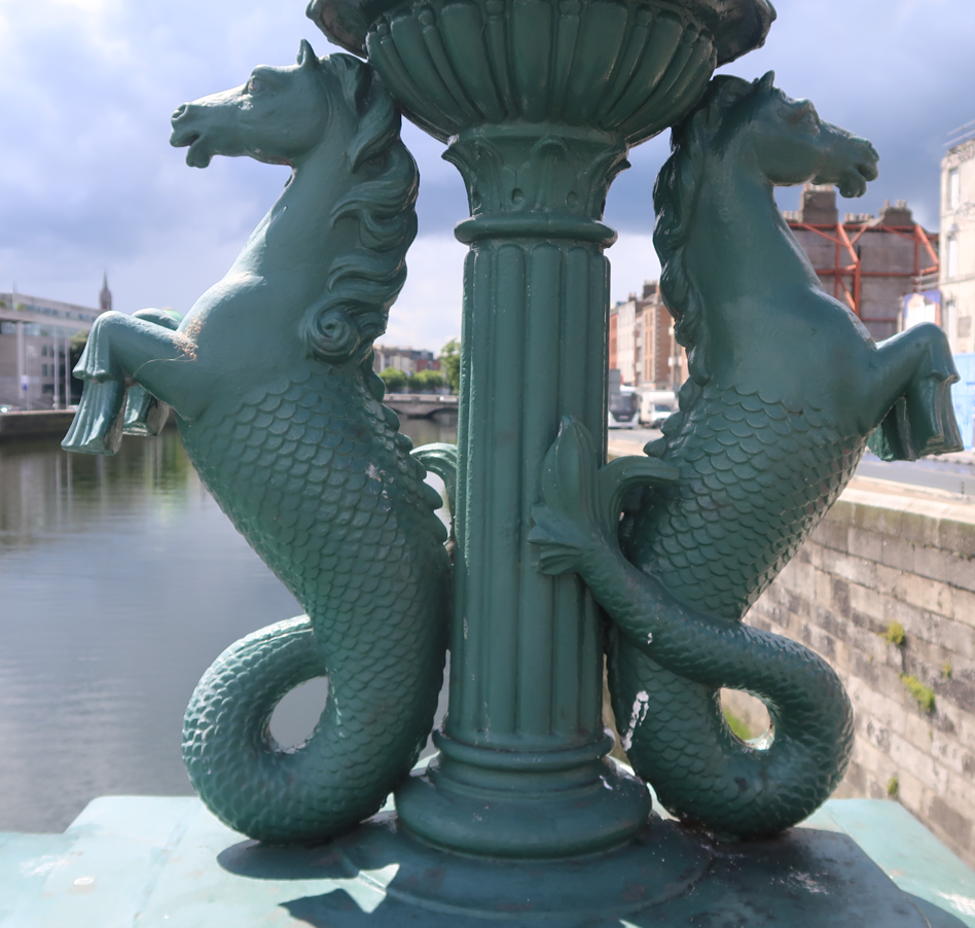
Wandering back along the River Liffey, seeing the mythical sea-creature ironwork adorn the modern bridges brings the entire journey full circle. From the 922 AD longphort at Limerick to the fortified walls of Waterford and the bustling saga-city of Dublin, the Norsemen didn't just raid Ireland—they helped build its urban foundation.


Comments